 Checkcraft
How to create API tests without code
Checkcraft is a desktop app for checking APIs and logs without code, with a free edition. Download, no sign-up →
If the same response needs checking after every release, save the expected result once. A useful first automated check is small enough that you can explain why it passes and why it fails.
You will import a test case, run it against two inputs and see the exact field that differs.
Create a place for the check
Create a workspace, then use the tree context menu to create a collection, a check and a test case. In the test case editor, use Import to load the file below. Import adds a new test case instead of replacing the one you have open.
Make the expectation explicit
The example checks status against OK. This is an expected business value, not an inference that every HTTP 200 response is correct. For your own API, take the expected value from the contract or an agreed requirement.
Prove the check can fail
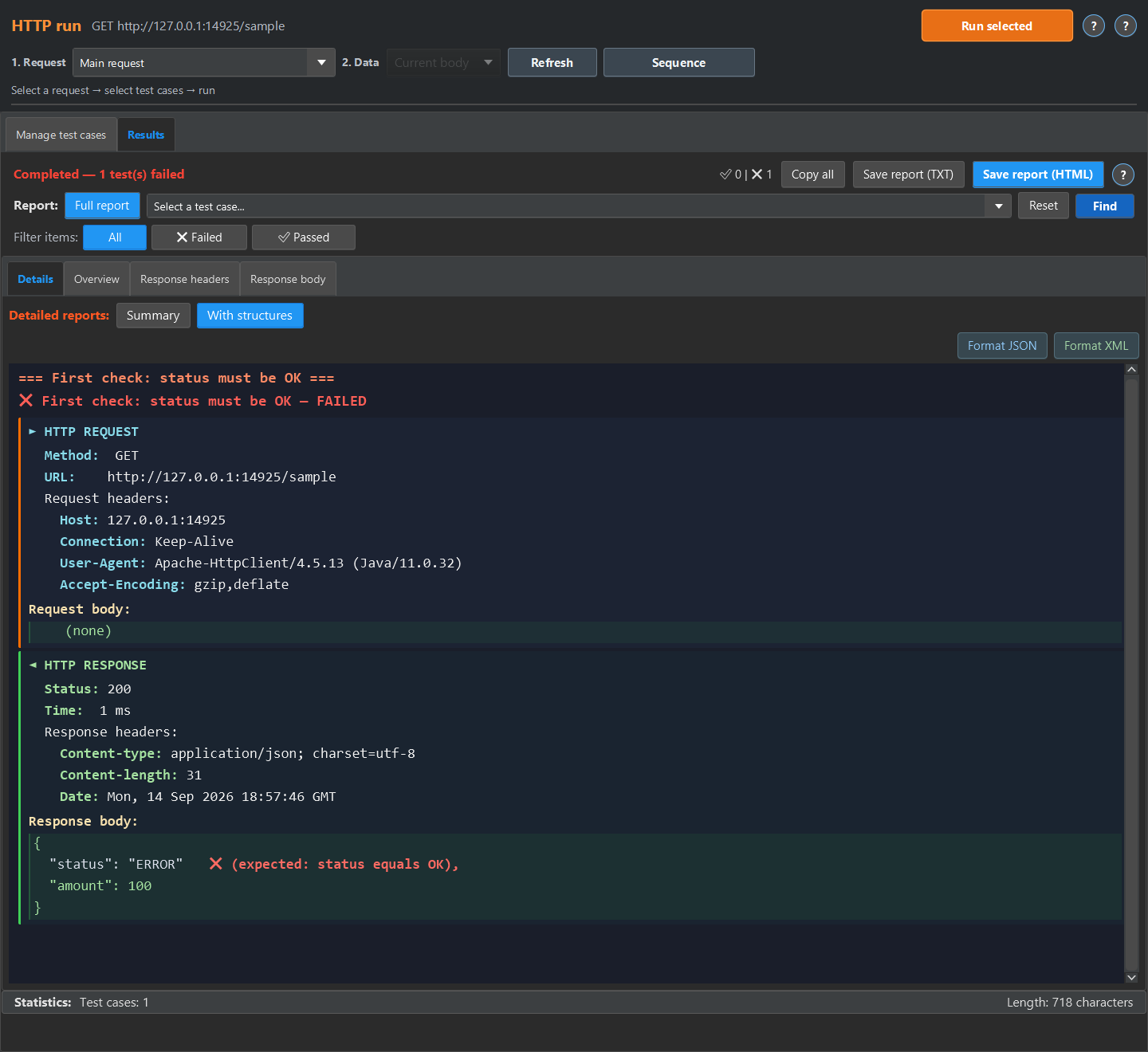
Paste the valid JSON with Paste data for analysis and click Run test case. Then paste the broken JSON and run the same steps again. Open Result and read the failed rule. Keep this negative example when you change the test.
Repeat the check with ready-made files
The quick experiment below runs in the test case editor. The screenshots show the detailed report available in HTTP run or Log run. For HTTP run, return the sample JSON or XML from a local mock and run the imported case against it, then open Results, Details and With structures. For Log run, load the sample into a log source, enable No request, run the case, then open Details and Detailed.
Download the Checkcraft test case and two inputs. One input is valid, and the other contains a deliberate error. These synthetic examples are available without registration.
Run the example in Checkcraft
Create a collection, a check and a test case using the workspace tree context menu. Click Import in the test case editor and choose the downloaded test case. Open the added case, copy the valid JSON, click Paste data for analysis, then Run test case. Open Result to inspect the report.
Repeat with the broken JSON without changing the rules. The first run should pass and the second should fail. If you see a different outcome, check the selected data source, imported steps and report.
The example files were executed against the application source on 14 September 2026. Reference reports in English are available for the passing run and failing run. Sample names and literal data values do not change when you switch the interface language.
Continue after the first exercise
Manual testers can save a repeatable assertion. Analysts can verify a requirement, then teams can rerun after a fix. Learning one tool does not replace learning the testing profession.
See the result on a small example first
Start with the sample, inspect the failure and then try a sanitized example from your own API. Free is available for Windows and Linux with no time limit.
Download FreeDownload and first runNo sign-up or email needed, the archive is ready in a couple of minutes. See the edition limits.